
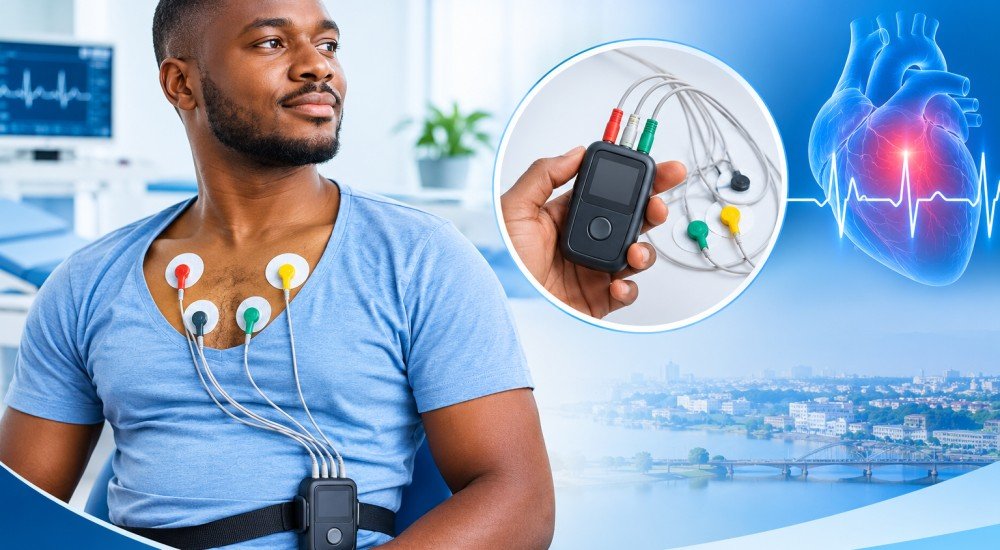
Holter Monitoring Services in Owerri
Extended Heart Rhythm Monitoring for Symptoms That May Come and Go
Some heart rhythm problems happen only occasionally. A person may experience a racing heartbeat, fluttering sensation, dizziness or an unexplained episode, yet have a normal heart rhythm by the time they reach a hospital or complete a short ECG.
This is where Holter monitoring can provide additional information.
At LifeWay Diagnostics, we provide Holter monitoring services in Owerri to record the heart’s electrical activity continuously over an extended period while you go about your normal daily activities.
Unlike a standard ECG, which records the heart’s electrical activity for a short period, a Holter monitor can continuously record your heart rhythm for a much longer period.
This can help your healthcare professional investigate symptoms that may not occur during a routine ECG.
Need Holter monitoring in Owerri? Contact LifeWay Diagnostics to enquire about availability and appointment requirements.
What Is Holter Monitoring?
A Holter monitor is a small portable device used to continuously record the heart’s electrical activity over an extended period.
The device is connected to small electrodes placed on the chest. These electrodes detect the heart’s electrical signals and transmit the information to the recording device.
You normally wear the monitor while continuing many of your usual daily activities.
Depending on the type of monitoring requested, recording may take place over 24 hours or longer.
The exact duration depends on the clinical reason for the test and the monitoring protocol prescribed by your healthcare professional.
Why Is Holter Monitoring Needed?
A standard ECG provides a short recording of your heart rhythm.
This can be extremely useful, but some heart rhythm abnormalities occur intermittently and may not happen during the few minutes when an ECG is being performed.
Your doctor may therefore recommend Holter monitoring when symptoms come and go.
Common reasons for Holter monitoring include investigation of:
Heart palpitations
Racing heartbeat
Fluttering or pounding sensations in the chest
Episodes of dizziness
Unexplained fainting or near-fainting
Irregular heartbeat
Suspected intermittent rhythm abnormalities
Symptoms that occur at different times during the day
Certain known heart rhythm conditions requiring monitoring
Holter monitoring may also be used to assess heart rhythm over an extended period in people with an existing cardiac condition.
What Symptoms May Lead to Holter Monitoring?
You may be referred for Holter monitoring if you experience symptoms such as:
Palpitations
You may feel as though your heart is:
Racing
Beating unusually slowly
Fluttering
Skipping beats
Pounding
Beating irregularly
Dizziness or Light-headedness
Some episodes of dizziness or light-headedness may be associated with changes in heart rhythm.
Fainting or Near-Fainting
If you have experienced unexplained fainting or episodes where you felt close to fainting, your doctor may consider longer-term heart rhythm monitoring.
Intermittent Symptoms
If symptoms occur unpredictably, continuous monitoring can increase the opportunity to record the heart rhythm around the time symptoms occur.
Holter Monitoring vs ECG
Holter monitoring and an ECG both record the heart’s electrical activity, but they are used differently.
ECG
A standard ECG usually provides a short recording of your heart’s electrical activity.
It can be useful for assessing the heart rhythm and electrical pattern at the time of the examination.
Holter Monitor
A Holter monitor records heart rhythm continuously over an extended period while you carry out many of your normal activities.
This makes it useful when symptoms are intermittent and may not occur during a routine ECG.
In simple terms:
ECG = short-term heart rhythm recording
Holter monitoring = extended heart rhythm recording
Your doctor may request one or both depending on your symptoms.
What Happens During Holter Monitoring?
The process is generally straightforward.
1. Preparing for the monitor
A healthcare professional will explain how the device works and how long you are expected to wear it.
Your chest may need to be prepared so the electrodes can maintain good contact with the skin.
2. Electrodes are attached
Small adhesive electrodes are placed at specific locations on your chest.
The electrodes are connected to the portable recording device.
3. The monitor is worn
The recording device is usually small enough to be carried discreetly.
Depending on the equipment being used, it may be worn around the waist, attached to clothing or carried in another suitable way.
4. Continue your normal activities
You will generally be encouraged to continue many of your normal daily activities while wearing the monitor, unless you are given specific restrictions.
5. Record relevant symptoms
You may be asked to keep a diary or note the time when you experience symptoms.
For example, you may be asked to record:
The time you felt a racing heartbeat
Dizziness
Chest discomfort
Shortness of breath
Fainting or near-fainting
Physical activity
Sleep
Other significant events
Recording the timing of symptoms can help the healthcare professional compare them with the heart rhythm recorded by the monitor.
6. Return the device
Once the monitoring period is complete, you will return the device according to the instructions provided.
The recorded information can then be reviewed as part of the diagnostic process.
What Should I Do While Wearing a Holter Monitor?
The purpose of Holter monitoring is often to record your heart rhythm during normal daily life.
Unless your healthcare professional gives you specific restrictions, you may generally continue your usual activities.
However, follow all instructions provided with your particular monitoring device.
You may be asked to:
Keep the monitor attached continuously.
Keep the electrodes securely connected.
Record symptoms in a diary.
Record the time of important activities.
Avoid activities that could damage the equipment.
Follow instructions regarding bathing or showering.
Can I Sleep While Wearing a Holter Monitor?
Yes. Holter monitors are designed to record your heart rhythm during day and night.
You will normally wear the monitor while sleeping unless your healthcare professional gives you different instructions.
Try to position the device safely and comfortably so that the electrodes remain attached.
Can I Shower While Wearing a Holter Monitor?
This depends on the specific monitor being used.
Some Holter monitoring devices are not waterproof and must not be exposed to water.
You should follow the instructions provided by the diagnostic team regarding bathing and showering.
Do not assume that your monitor is waterproof.
Ask the healthcare professional before exposing the device or electrodes to water.
Is Holter Monitoring Painful?
Holter monitoring itself is generally painless.
The adhesive electrodes attached to your chest may cause minor skin irritation in some people.
You may also notice mild discomfort when the electrodes are removed.
If you experience significant skin irritation, inform the healthcare professional managing your monitoring.
How Long Do You Wear a Holter Monitor?
The monitoring duration depends on the type of device and the clinical reason for the examination.
A traditional Holter monitor is commonly used for 24 hours, while some monitoring arrangements may continue for longer.
Your healthcare professional will tell you exactly how long you should wear the monitor.
What Can Holter Monitoring Detect?
Holter monitoring can provide information about the heart’s rhythm over an extended period.
It may help healthcare professionals identify or investigate:
Abnormally fast heart rhythms
Abnormally slow heart rhythms
Irregular heartbeats
Extra heartbeats
Pauses in heart rhythm
Changes in heart rhythm that occur intermittently
The relationship between reported symptoms and recorded heart rhythm
The significance of a particular rhythm finding depends on the patient’s medical circumstances.
Can Holter Monitoring Detect Palpitations?
Holter monitoring can be particularly useful when investigating palpitations that happen intermittently.
If you experience a palpitation while wearing the monitor, recording the time and symptoms can help the healthcare professional compare the event with the heart rhythm recorded at that moment.
However, if symptoms do not occur during the monitoring period, the test may not capture the rhythm responsible for those symptoms.
Your doctor may recommend longer or different types of monitoring if necessary.
What If I Do Not Have Symptoms During the Test?
It is possible to complete a Holter monitoring period without experiencing the symptoms that led to the test.
This does not necessarily mean that nothing is wrong.
If symptoms are very infrequent, your doctor may consider whether a longer monitoring period or another type of cardiac monitoring would be more appropriate.
Your healthcare professional will determine the next step based on your symptoms and clinical history.
What Happens After Holter Monitoring?
After the monitoring period, the device is returned according to the instructions provided.
The recorded information is then processed and reviewed as part of the diagnostic process.
Your doctor may compare the heart rhythm recording with:
Your symptom diary
The times you experienced palpitations
Your activity levels
Previous ECG results
Medical history
Other cardiac investigations
The results can help your doctor determine whether further investigation or management is necessary.
Holter Monitoring and Exercise
Your doctor may want the monitor to record your heart rhythm while you carry out normal daily activities.
Whether you should engage in strenuous exercise depends on your individual circumstances and the reason for the monitoring.
Follow the instructions given by your healthcare professional.
If exercise or physical activity normally triggers your symptoms, tell your doctor before the monitoring begins.
Holter Monitoring and Medication
Continue taking prescribed medication unless your doctor specifically tells you otherwise.
Some medications can affect heart rate or rhythm, so it is important that the healthcare professional knows which medicines you are taking.
Do not change or stop medication simply because you are wearing a Holter monitor unless you have been specifically instructed to do so.
Is Holter Monitoring Safe?
Holter monitoring is generally considered safe and non-invasive.
The monitor records electrical activity through electrodes placed on the skin.
It does not normally deliver electrical shocks or send electricity into your heart.
The main inconvenience may be wearing the device for an extended period or experiencing minor skin irritation from the electrodes.
Who May Need Holter Monitoring?
A doctor may recommend Holter monitoring for someone experiencing:
Recurrent palpitations
Unexplained dizziness
Unexplained fainting
Intermittent irregular heartbeat
Episodes of racing heartbeat
Symptoms that are not captured by a standard ECG
Certain known rhythm abnormalities
It may also be used when a healthcare professional wants to evaluate heart rhythm over an extended period.
The decision to use Holter monitoring should be based on the patient’s symptoms and clinical assessment.
Holter Monitoring vs Echocardiography
These tests examine different aspects of the heart.
Holter Monitoring
Records the electrical activity and rhythm of the heart over an extended period.
Echocardiography
Uses ultrasound to examine the structure and function of the heart.
An echocardiogram can provide information about heart chambers, valves, heart muscle movement and blood flow.
Your doctor may request both tests because they provide different information.
Holter Monitoring vs Ambulatory Blood Pressure Monitoring
Holter monitoring and ABPM are both forms of extended monitoring, but they measure different things.
Holter Monitoring
Records heart electrical activity and rhythm.
Ambulatory Blood Pressure Monitoring
Measures blood pressure at regular intervals over an extended period.
A doctor may recommend one or both depending on the symptoms and clinical question.
Why Choose LifeWay Diagnostics for Holter Monitoring in Owerri?
At LifeWay Diagnostics, Holter monitoring forms part of our broader Clinical Physiology and cardiac diagnostic services.
We provide a professional environment for patients who require extended heart rhythm monitoring following medical referral or clinical assessment.
Our approach focuses on:
Professional cardiac diagnostic services
Patient-focused care
Appropriate monitoring procedures
Modern diagnostic equipment
Support for doctor referrals
Access to complementary cardiac investigations
Clear instructions on using the monitoring equipment
Whether you are being investigated for unexplained palpitations, dizziness, fainting or intermittent heart rhythm symptoms, our team can assist with your Holter monitoring appointment.
Cardiac and Clinical Physiology Services at LifeWay Diagnostics
Holter monitoring is one part of LifeWay Diagnostics’ wider range of Clinical Physiology services.
Depending on your symptoms and clinical needs, your doctor may recommend additional investigations.
ECG in Owerri
Records the electrical activity and rhythm of the heart during a short examination.
Echocardiography in Owerri
Uses ultrasound to assess the structure and function of the heart.
Ambulatory Blood Pressure Monitoring
Provides blood pressure measurements at intervals during normal daily activities.
Clinical Physiology
Explore our wider range of cardiac, respiratory, neurological and other physiological investigations.
Radiology & Medical Imaging
Access diagnostic imaging services including MRI, CT, ultrasound, X-ray and mammography.
When Should You Seek Urgent Medical Attention?
Holter monitoring is a diagnostic test and is not a substitute for emergency medical care.
If you experience severe or persistent chest pain, severe difficulty breathing, fainting, or other serious symptoms, seek urgent medical attention.
If you experience a rapid or irregular heartbeat accompanied by severe dizziness, chest pain, difficulty breathing or loss of consciousness, seek immediate medical care rather than waiting for a routine Holter appointment.
Frequently Asked Questions About Holter Monitoring in Owerri
What is a Holter monitor?
A Holter monitor is a portable device that continuously records the heart’s electrical activity over an extended period, commonly 24 hours or longer depending on the monitoring plan.
Why would I need Holter monitoring?
Holter monitoring may be recommended when symptoms such as palpitations, dizziness or fainting happen intermittently and may not be captured during a short ECG.
Is a Holter monitor the same as an ECG?
Both record the heart’s electrical activity, but an ECG is usually a short recording while a Holter monitor records continuously over a much longer period.
How long do I wear a Holter monitor?
The duration depends on the type of monitor and the reason for the test. Traditional Holter monitoring is commonly performed for 24 hours, although longer monitoring may sometimes be used.
Can I sleep while wearing a Holter monitor?
Yes. Holter monitoring is generally designed to record heart rhythm during both waking and sleeping hours.
Can I shower while wearing a Holter monitor?
This depends on the specific device. Some monitors are not waterproof. Follow the instructions provided by the diagnostic team and ask before exposing the equipment to water.
Can I work while wearing a Holter monitor?
In many cases, you can continue normal daily activities while wearing the monitor, but you should follow any restrictions provided by your healthcare professional.
What if I experience symptoms while wearing the monitor?
Record the time and nature of your symptoms as instructed. This may help the healthcare professional compare your symptoms with the heart rhythm recorded at that time.
Can Holter monitoring detect an irregular heartbeat?
Holter monitoring can record heart rhythm continuously and may identify intermittent rhythm abnormalities that do not occur during a short ECG.
What happens if my symptoms do not occur during Holter monitoring?
Your doctor may consider whether additional or longer-term monitoring is appropriate, depending on how frequently your symptoms occur and your clinical circumstances.
Is Holter monitoring painful?
No. The monitoring itself is generally painless, although the adhesive electrodes may occasionally cause mild skin irritation.
Can I exercise while wearing a Holter monitor?
This depends on your medical circumstances and the instructions provided by your healthcare professional. Follow the activity guidance given for your monitoring period.
Where can I get Holter monitoring in Owerri?
LifeWay Diagnostics provides Holter monitoring as part of its Clinical Physiology and cardiac diagnostic services in Owerri. Contact the centre to confirm availability and appointment requirements.
Book Holter Monitoring in Owerri
If you have been referred for Holter monitoring or your doctor wants to investigate intermittent heart rhythm symptoms, LifeWay Diagnostics can assist you with your diagnostic appointment.
Contact LifeWay Diagnostics to enquire about Holter monitoring in Owerri, confirm appointment requirements and get directions to the centre.
ections